To prepare your skin for resurfacing, Dr. Batniji may start you on a bleaching cream and a retinol or retinoic acid. Use these products nightly. Stop them 1 week before your procedure. It is important you use a high quality sunscreen while using these products.
1 week prior to your procedure:
- Avoid excessive sun exposure or tanning.
- Discontinue the use of facial exfoliants (scrubs, washes, and other treatments such as microdermabrasion that remove the outermost layer of skin).
- Discontinue the use of products containing topical retinoids/retinoic acids, including Retin-A, Avage, Differin, Ultra A, Tazorac, and Renova.
Review the prescriptions provided by Dr. Batniji. You will be asked to start anti-viral and antibiotic medications prior to your procedure.
- On the day of your treatment:
- Do not wear contact lenses.
- Do not wear make-up or use any other facial products, such as a moisturizer. Do not use mascara.
- Wash your face with a gentle cleanser like Cetaphil prior to arrival for your procedure.
- If your procedure is performed in the office, please bring a headband with you to the office. This will be used to hold your hair away from the laser treatment areas.
- You may wish to arrange for a driver to bring you to the office and take you home after the procedure.
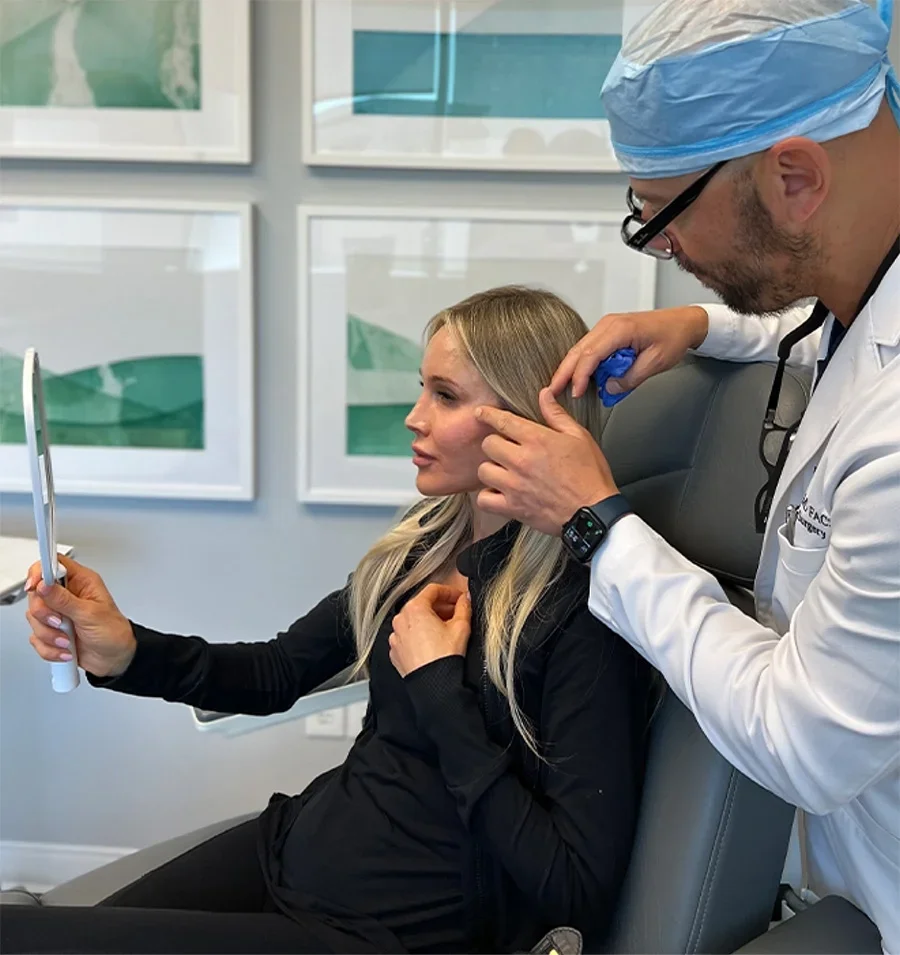
- Once you arrive to the office for your procedure, Dr. Batniji may take pre-treatment photographs. Then, a topical anesthetic cream will be applied for approximately 60 minutes prior to the procedure to numb the treatment areas.
- After the procedure, a layer of either Alba Un-Petroleum Jelly or Aquaphor will be applied to the treated areas.
- Your treated skin must be covered with either Alba Un-Petroleum Jelly or Aquaphor continuously for the first 24 hours after treatment. Please do not remove for the first 24 hours.
Post-procedure care instructions:
- After the first 24 hours, please wash the treated areas with a gentle cleanser like Cetaphil to gently remove the Aquaphor or Alba Un-Petroleum Jelly. Always wash your hands thoroughly using antibacterial soap before touching the treated skin.
- Wash your face 3-6 times a day after the first 24 hours.
- Following cleansing, you may want to use a white vinegar solution to ease any discomfort, such as itching.
- Mix a solution of 1 teaspoon white vinegar with 1 cup cold water.
- Gently dab the mixture onto the treated areas using a clean washcloth or gauze.
- Following the white vinegar solution treatment, the area should be gently rinsed with water and dried with a clean washcloth.
- You may perform this white vinegar solution treatment 3 times a day.
- For itching, consider using Benadryl.
- Apply Aquaphor or Alba Un-Petroleum Jellyimmediately after cleansing. It is imperative that the treated skin does not dry out; otherwise it may increase the risk of scar formation and/or infection. To that end, please reapply the Aquaphor or Alba Un-Petroleum Jelly if the treated skin feels tight or dry.
- Apply a thicker layer of Aquaphor or Oxygenetix at nighttime.
- Try to sleep on your back following treatment with the head of the bed slightly elevated to minimize swelling after the procedure. Using an extra pillow will help facilitate head of bed elevation.
- We recommend you place a Terry Cloth towel on your pillow to minimize the sticking of your face to the pillow.
- Avoid rubbing the treated areas. Also, avoid removing flaking or peeling skin. Rather, allow this skin to peel on its own. Rubbing and/or removing flaked/peeled skin may increase the incidence of scar formation.
- New skin will have formed underneath the layer of the treated skin that flakes/peels. Your new skin will be fragile and must be treated gently. This includes a high quality moisturizer and sunblock. Dr. Batniji and staff will instruct you when it is time to discontinue the Aquaphor or Alba Un-Petroleum Jelly.
Contact Dr. Batniji and staff if you begin to experience any of the following:
- Cold sores/Fever blisters
Signs of infection, such as increased itching, pain, swelling, pus, or oozing.